

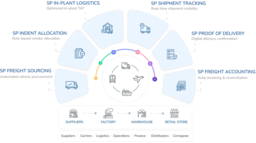





A transport management system (TMS) plans, executes and settles freight movements: it turns orders into loads, chooses vehicles or carriers, dispatches trucks, tracks consignments to proof of delivery, and reconciles freight bills. For Indian shippers (manufacturers, distributors) and third-party logistics providers (3PLs), a TMS is justified once you move enough full-truck-load or part-truck-load freight that manual indenting, phone-based tracking and spreadsheet freight settlement cause delays, detention and billing disputes. Indian platforms such as Fretron, Fleetx, SuperProcure, Shipsy and Locus cover different parts of that workflow, and enterprise options include Oracle Transportation Management. None of them publishes prices on the public pages we reviewed. This guide is about freight and fleet TMS; for parcel shipping aggregators used by D2C and B2B brands, see our logistics and shipping software guide.
Executive summary
- A TMS earns its cost in freight procurement and settlement, not only tracking. Competitive indenting to transporters, accurate detention records and automated freight bill audits are where Indian shippers typically find the largest savings.
- Shippers and 3PLs need different TMS shapes. Shippers want carrier procurement, dispatch planning, visibility and freight audit. 3PLs and fleet owners want trip management, fleet costing, driver settlement, customer billing and multimodal handling.
- E-way bill compliance is part of TMS design. Goods movements above Rs 50,000 require an e-way bill, and after generation only Part-B (transport details) can be updated. A TMS that tracks validity and Part-B changes reduces in-transit compliance risk.
- Pricing is quote-only across the Indian TMS vendors we checked. Fretron states that pricing is worked out one-on-one; Fleetx does not display prices. Build a shipment- or vehicle-based cost model before negotiating.
- Integration is the main implementation risk. Orders must flow from the ERP, e-way bills from the GST system, and invoices back to accounting. Budget more time for integration than for configuration.
Market context
There is no official Indian government statistic on TMS adoption or market size, and we do not cite private estimates. The following primary sources frame the demand.
Industrial output. MoSPI's Quick Estimates of the Index of Industrial Production for May 2026, on the new 2022-23 base, show 5.1% year-on-year growth, with manufacturing growing 5.5% and electricity and gas supply 9.9%. Primary and finished goods from these sectors move largely in trucks between plants, depots, distributors and ports, and that inbound and outbound freight is what a shipper TMS manages.
GST movement documentation. The e-way bill system is used by GST-registered persons and enrolled transporters to generate an e-way bill on commencement of movement of goods exceeding Rs 50,000 in value. The official FAQ confirms that an e-way bill cannot be edited once generated apart from updating Part-B, and that validity depends on the distance goods must travel, with a separate, shorter distance-per-day basis for over-dimensional cargo. For multimodal and multi-vehicle movements, every transhipment is a Part-B update that a TMS should capture.
Fragmented carrier base. The Ministry of MSME reported over 7.83 crore enterprises registered on the Udyam portals as of 28 February 2026. Many transporters and fleet owners that shippers contract with are small businesses, so a TMS must work with carriers who use a phone app or WhatsApp rather than an API.
Road safety and tracking rules. For passenger fleets, MoRTH's Rule 125H mandate requires certified vehicle location tracking devices. Goods fleets rely more on driver apps, SIM-based tracking or telematics devices, which is why most Indian TMS products offer several tracking methods.
Data protection. Driver phone numbers, SIM-based location and consignee details are personal data under the DPDP Act, 2023. The DPDP Rules, 2025 phase in obligations over 18 months from November 2025.
TMS scope in Indian B2B logistics.
| Workflow | Shipper TMS | 3PL / fleet TMS |
|---|---|---|
| Order and indent | Orders from ERP; indent to transporters | Customer orders, bookings, LR (lorry receipt) creation |
| Freight procurement | Spot and contract bidding, rate contracts | Market vehicle sourcing, broker management |
| Planning | Load building, vehicle type selection, route planning | Trip planning, backhaul matching |
| Execution | Vehicle placement, loading, gate-out | Dispatch, driver advances, fuel |
| Visibility | SIM, app or GPS tracking; ETA alerts | Same, plus own fleet telematics |
| Delivery | ePOD, shortages and damages | ePOD, claims |
| Settlement | Freight bill audit, detention, payment | Customer invoicing, driver and vendor settlement |
Evaluation framework
App Advisor methodology: weighted criteria for transport management systems for Indian shippers and 3PLs. Weights total 100.
| Criterion | Weight | What good looks like |
|---|---|---|
| Freight procurement and rate management | 15 | Spot bids, contract rates by lane and vehicle type, transporter scorecards |
| Planning and optimisation | 15 | Load and route optimisation, vehicle type selection, multi-drop planning |
| Execution and visibility | 15 | Multiple tracking options (driver app, SIM, GPS), ETA, exception alerts, geofenced loading/unloading times |
| ePOD, claims and detention | 10 | Photo and signature POD, shortage/damage recording, detention time from geofence data |
| Freight settlement and billing | 15 | Automated freight bill audit against rates and POD; customer invoicing for 3PLs; accounting integration |
| Compliance | 10 | E-way bill generation or integration, Part-B updates, validity alerts, document storage |
| Integration | 15 | ERP (SAP, Oracle, Tally, others), WMS, e-way bill APIs, carrier onboarding without IT |
| Commercial clarity | 5 | Clear pricing basis (per shipment, per vehicle, per user), implementation fee stated |
Vendor comparison
Official pricing only. None of these vendors displays prices on the public pages we reviewed.
| Product | What the official site describes | Published pricing | Best fit |
|---|---|---|---|
| Fretron | Dispatch planning and automation, load and route optimisation, freight procurement and carrier management, EXIM and cross-border logistics, ePOD and claims management, freight billing and settlement (site) | Not published; the site says pricing is worked out one-on-one | Indian shippers and 3PLs wanting an end-to-end road freight TMS |
| Fleetx | Transport Management System to plan, dispatch and settle freight end to end, alongside fleet visibility, video, fuel monitoring and transport ERP (site) | Not published on the page we could access | Fleet owners and 3PLs combining own-fleet telematics with TMS |
| SuperProcure | Freight procurement and transport management for shippers | Quote | Shippers focused on transporter bidding and indent management |
| Shipsy | Logistics management platform for shippers, 3PLs and couriers | Quote | Enterprises with multimodal, first-mile, mid-mile and last-mile needs |
| Locus | Route optimisation and dispatch management | Quote | Distribution-heavy businesses optimising multi-drop routes |
| Oracle Transportation Management | Enterprise TMS within Oracle SCM | Quote | Large enterprises on Oracle ERP with global freight |
| Intugine | Shipment visibility and logistics tracking | Quote | Shippers prioritising multi-carrier tracking |
For freight forwarders and courier businesses that mainly need billing and accounting, see freight forwarding and courier billing software. For software logistics providers' ERPs, the catalogue also lists Softlink Logi-Sys.
Total cost of ownership
Illustrative model — assumptions stated. Because no vendor publishes prices, the licence line uses a placeholder. The purpose is to show which cost and benefit lines matter.
Assumptions for a manufacturer dispatching 1,200 full-truck-load shipments a year:
- TMS subscription: ₹P per shipment (placeholder; some vendors price per vehicle or per user instead).
- One-time implementation and ERP integration: ₹I (placeholder).
- Internal project team: logistics manager at 30% time and IT analyst at 30% time for 4 months, at an assumed combined ₹1,20,000 per month cost to company.
- Freight bill audit time today: 45 minutes per shipment at an assumed ₹500 per hour; TMS automation assumed to cut this to 10 minutes.
- Detention disputes: tracked separately from your own data.
| Line | Year 1 | Year 2 | Year 3 |
|---|---|---|---|
| Subscription | 1,200P | 1,200P | 1,200P |
| Implementation and integration | I | – | – |
| Internal project team (0.6 FTE-equivalent cost × 4 months) | ₹1,44,000 | – | – |
| Cost total | 1,200P + I + ₹1,44,000 | 1,200P | 1,200P |
| Audit time saved: 1,200 × 35 min × ₹500/h | ₹3,50,000 | ₹3,50,000 | ₹3,50,000 |
The audit-time saving is only one benefit line. Add competitive freight rates from bidding, reduced detention charges and fewer e-way bill penalties once you have three months of TMS data compared with your baseline. Avoid using vendor-claimed percentage savings in your business case.
Implementation roadmap
| Phase | Weeks | Activities | Output |
|---|---|---|---|
| 1. Baseline and scope | 1–3 | Map lanes, volumes, vehicle types, transporters, current rate contracts, freight bill process and e-way bill process | Scope document and baseline KPIs |
| 2. Selection | 3–7 | Scripted demos using 3 real lanes; test transporter app with 2 real carriers; review integration approach and quotes | Signed contract |
| 3. Master data | 6–9 | Load plants, depots, customers, lanes, rate contracts, transporters and vehicle types | Validated masters |
| 4. Integration | 7–12 | ERP order and invoice integration; e-way bill API or process; accounting export | Tested interfaces |
| 5. Pilot | 12–15 | One plant or region; parallel run with old process for 2 weeks | Pilot report |
| 6. Carrier onboarding | 13–18 | Train transporters on indent acceptance, tracking consent and ePOD; publish SOP | Onboarded carriers |
| 7. Rollout and audit automation | 16–22 | Remaining plants; switch on freight bill audit; monthly transporter scorecards | Live network |
Risks and compliance checklist
- E-way bill. Generate for movements above Rs 50,000; update Part-B when vehicles change; monitor validity; keep audit trail of updates.
- Lorry receipts and contracts. Keep transporter contracts, LR terms and liability clauses digitised and linked to shipments.
- Driver consent for tracking. SIM-based and app tracking involve personal data; capture consent and give notice under the DPDP framework.
- Data sharing with carriers. Share only what carriers need (pickup, drop, contact) and restrict consignee data.
- Integration failure. Plan manual fallback for indents and e-way bills if an interface fails.
- Rate governance. Lock rate contracts and require approvals for spot rates above thresholds.
- Freight payments and GST. Confirm how the TMS handles GST on freight (including reverse charge scenarios) with your tax advisor before automating settlement.
- Carrier adoption. Small transporters may resist apps; plan incentives, simple interfaces and phone support.
KPIs to track
| KPI | Definition | Why it matters |
|---|---|---|
| Indent acceptance rate | Indents accepted by the assigned transporter ÷ indents placed | Carrier reliability |
| Vehicle placement on time | Vehicles reporting by the committed time ÷ total | Plant dispatch planning |
| Loading and unloading turnaround | Hours in geofence at origin and destination | Detention and productivity |
| On-time delivery | Deliveries within promised window ÷ total | Customer service |
| Freight cost per tonne-km | Freight spend ÷ tonne-km moved | Comparable cost across lanes |
| Spot vs contract share | Spot shipments ÷ total shipments | Procurement discipline |
| ePOD within 24 hours | PODs received within a day of delivery ÷ total | Faster billing and payment |
| Freight bill accuracy | Bills passed without correction ÷ bills received | Audit effectiveness |
| E-way bill exceptions | Expired or mismatched e-way bills in transit | Compliance risk |
How to choose
- Shipper or 3PL? Choose products designed for your side of the contract. A shipper TMS rarely handles driver settlement well; a fleet TMS rarely handles multi-transporter bidding well.
- Start with the costliest pain. If freight rates are the issue, lead with procurement. If detention and disputes are the issue, lead with visibility and ePOD.
- Test with real carriers. Invite two of your smaller transporters to the demo.
- Check ERP integration references. Ask for an Indian reference customer on your ERP.
- Insist on data export. Lane rates, trips and PODs are your data.
- Clarify the pricing basis. Per shipment, per vehicle or per user changes the economics as you scale.
Questions to ask vendors before signing
- What is the pricing basis, and what happens when volume grows? Per-shipment, per-vehicle and per-user models behave very differently as you add plants or lanes. Ask for pricing at your current volume and at double that volume.
- How do small transporters participate? Ask to see the transporter experience for indent acceptance, vehicle details, tracking consent and ePOD on a basic smartphone.
- Which tracking methods are included? Driver app, SIM-based tracking and GPS device integration each have different accuracy, consent and cost implications.
- How are e-way bills handled? Confirm whether the TMS generates e-way bills, updates Part-B, or only stores numbers from your ERP, and who manages the GST credentials.
- How does freight audit work? Ask for a demonstration of a freight bill matched automatically against contracted rates, detention records and PODs.
- What ERP integrations have been delivered in India? Request references on your ERP and ask how long integration took.
- Can we export all data? Lane rates, trips, PODs and transporter scorecards should be exportable at any time.
- What does support look like during dispatch hours? Plants often dispatch late at night; confirm support hours match your operations.
If you own trucks, pair a TMS with fleet management and GPS tracking software. For warehousing, see inventory and warehouse management software. Browse the logistics software category and fleet management.
FAQs
What is a transport management system?
A TMS is software that plans, executes and settles freight movements. It covers order-to-load planning, carrier selection, dispatch, tracking, proof of delivery and freight billing.
What is the difference between a TMS and shipping software?
Shipping software, such as courier aggregators, books parcels with courier companies and prints labels. A TMS manages truckload and part-truckload freight, contracts with transporters, dispatch planning and freight settlement.
Is there multimodal logistics software for India?
Several platforms describe multimodal capabilities, including EXIM and cross-border modules (Fretron lists EXIM and cross-border logistics). Check how each handles transhipments, port or rail legs, and e-way bill Part-B updates for every leg.
How is TMS priced in India?
The Indian TMS vendors we reviewed do not publish prices. Common pricing bases are per shipment, per vehicle, per user or a platform fee, plus implementation. Ask for a quote on the same basis from every vendor.
Can a TMS generate e-way bills?
Some TMS products generate or update e-way bills through authorised integrations; others import e-way bill numbers from the ERP. Confirm the exact method and who holds the GST credentials.
Do small transporters need to install an app?
Many Indian TMS products support SIM-based tracking with consent, which does not need an app, as well as driver apps and GPS devices. Choose methods that your carriers will actually use.
How long does TMS implementation take?
For a single plant or region, a pilot often takes about three to four months including integration; wider rollouts take longer. Integration with ERP and carrier onboarding are the usual bottlenecks.
Sources
- IIP Quick Estimates, May 2026 (MoSPI): https://www.mospi.gov.in/uploads/latestReleases/latest_release_1782727994645_1af6a37e-b7fb-4ee8-bf52-96fcea2a47e2_IIP_Press_release_May_2026.pdf
- E-way bill system (GSTN): https://ewaybillgst.gov.in/
- E-way bill FAQ (GSTN): https://docs.ewaybillgst.gov.in/html/faq.html
- Udyam registrations (PIB, Ministry of MSME): https://www.pib.gov.in/PressReleasePage.aspx?PRID=2246892®=3&lang=1
- MoRTH on GPS tracking for public service vehicles (PIB): https://www.pib.gov.in/PressReleasePage.aspx?PRID=1563379
- DPDP Rules, 2025 notified (PIB): https://www.pib.gov.in/PressReleasePage.aspx?PRID=2190014®=3&lang=2
- Fretron: https://www.fretron.com/
- Fleetx: https://www.fleetx.ai/